
You’re Not the Only One: The Overlooked Power of Sharing in Career Change
How sharing with other women can makecareer change feel less lonely
and more possible.
Questioning your career can feel surprisingly private. You may have spent years building experience and establishing yourself, only to find yourself wondering whether your current role still fits. You might want more meaning, greater balance, or an entirely different kind of challenge.
Or perhaps you feel you should already know what you want next because you have so much experience behind you.
When you are navigating this alone, the internal pressure builds. But hearing another woman describe a similar struggle can instantly change the conversation. Suddenly, you realize:
I’m not behind.
I’m not the only one questioning this.
I don’t need to have the answer yet.
It doesn’t give you an immediate solution, but it gives you permission to explore.
What happens when you don’t work it out alone?
When you question your career, you aren’t just making a practical decision about work. You are questioning your confidence, your identity, and what you want this next stage of your life to look like. Research shows that these transitions deeply affect how women see themselves, their relationships, and what they believe is possible for their future.
There is a distinct magic that happens when you navigate this alongside other women. A 2025 study of women-only group coaching found that participants developed significantly higher levels of courage and bridging social capital — the value we gain from connections outside our usual circles through fresh perspectives, information, and opportunities.
I see this unfolding directly within my Clarity & Courage cohort — a small group experience I created for six women to spend three months slowing down, looking closely at where they are, and mapping out what needs to change.
Because hearing another woman describe a similar struggle instantly changes the internal conversation.
You don’t need the same answers!
There can be a temptation to think that a group only works when everyone is on the exact same path. I’ve found the opposite.
The women in my cohort have wildly different careers, responsibilities, and circumstances. Some are tweaking their current roles; some are thinking about a completely different direction; others just know their career needs to change but aren’t yet clear on what that looks like. They aren’t looking for identical answers.
What they do share is a stage of life. In midlife, the way we think about work, identity, and priorities naturally shifts. That shared vantage point creates a powerful kind of resonance:
Shared Vulnerability: When one woman speaks a doubt aloud, another recognises herself in it. A concern that felt intensely personal suddenly becomes familiar.
Articulating the Unspoken: Hearing someone voice a thought you’ve struggled to put into words helps you understand your own thinking.
Expanded Horizons: When someone sees a possibility that another woman hadn’t considered, it opens up a new way of thinking and makes a seemingly unrealistic path feel attainable.
You don’t need someone to have your exact resume to learn from them. Sometimes, sharing the same stage of life is enough to make the conversation feel transformative.
Personal doesn’t have to mean solitary.
As our sessions continue, I am struck by how much courage shows up in the quiet moments. Sometimes courage isn’t a dramatic leap or a massive announcement. Sometimes it is simply saying out loud: “I’m not sure this is working for me anymore,” or allowing yourself to explore an option before you know if it will succeed.
Having other women alongside you makes those conversations easier to have.
Career transitions are deeply personal, but they do not have to be solitary. You can own your individual decision while still surrounding yourself with people who understand the weight of the question. Not people who tell you what your next chapter should look like, but people who listen, challenge your assumptions, and remind you that uncertainty doesn’t mean you’re doing it wrong.
They aren’t there to solve each other’s careers or hand out generic advice. They are there to listen and reflect.
I started this cohort knowing that coaching could help women create greater clarity and confidence. What I didn’t fully appreciate was how much being alongside each other would become the catalyst for the process itself. As a coach, I provide the structure, the questions, and the space for reflection. But the women bring the depth, and the group creates the connection.
Ultimately, the most powerful thing a woman can hear when she’s standing at a career crossroads isn’t a roadmap. It is simply:
“I’ve felt that too.”
Knowing you’re not the only one is exactly what makes the next step easier to take.
Share this article


What If Your Career Path Makes More Sense Than You Think?
Your career is a story, not a straight line.
We’re often encouraged to look back at our career choices and ask ourselves what we would have done differently.
But what if the more useful question isn’t about regret at all?
I was asked a version of that question recently, after mentioning that I’ve had several career changes.
My answer was straightforward: No, I don’t regret any of them.
Every role and every change gave me the opportunity to grow, gain new skills, and build a strong, flexible experience. More importantly, it allowed me to connect with diverse people.
Even the choices that didn’t turn out as I expected became part of what I know about myself today. And perhaps that is what makes looking back at our careers so interesting.
Not everything makes sense when we look at it as an individual decision. But when we look at the bigger story, we can often see connections we couldn’t see at the time.
Our career stories begin before we have a career.
I was reminded of this recently when talking with two women about career change and what we wanted to become when we were children.
I was eight years old and wanted to become very rich. I had decided that being a butcher, owning a funeral home or becoming a notary would get me there. I know!
It sounds completely random now. But looking back, I can see some early clues: I was drawn to things that felt stable, established, and connected to planning for the future.
Of course, I had no idea what any of that meant at eight. But perhaps our career stories start before we ever have a career.
Long before we choose a degree or our first job, we are already absorbing ideas about work, success, security and what a good working life looks like.
Then life happens.
We gain experience. Our circumstances change. Our priorities shift. We discover new interests and new parts of ourselves.
And our values can evolve too. What mattered most to us at 30 may not be what matters most to us at 40, 45 or 50.
Our careers evolve with us.
There isn’t one way to build a career. For a long time, the traditional career story was relatively simple:
Study → get a job → progress → become more senior → retire.
But careers don’t always work like that.
Some people follow a relatively linear path, developing within one profession or organisation.
Others move between industries, roles and organisations.
Some create businesses, take career breaks, change direction or reinvent themselves later in life.
One path isn’t intrinsically better than another. Research into careers increasingly reflects this complexity.
Mark Savickas’s work on Career Construction and Life Design, for example, starts from the idea that we are not simply choosing a career. We are constructing a career story from our experiences and the meaning we make of them.
Life Design also recognises that careers rarely unfold exactly as planned. Career adaptability is an important part of this thinking: our ability to stay curious, take some control, prepare for what might come next and have confidence in navigating change.
This connects with the idea of cognitive flexibility — our ability to adapt our thinking, behaviour and sense of identity as circumstances change.
As the Age Action Alliance recently highlighted, women often practise this kind of flexibility throughout their lives, through the many transitions and changing roles they navigate.
It is a reminder that the experience of change can itself build valuable adaptability.
The Protean Career perspective adds another dimension. It suggests that careers can be guided by personal values and fulfilment rather than traditional promotions or external metrics of success.
Together, these ideas challenge the assumption that a successful career has to be a straight line. They also offer another way of looking at the winding paths many of us have taken.
Perhaps they aren’t evidence that we got lost. Perhaps they are evidence that we changed.
Because the career that fitted you at 30 may not fit the person you’ve become at 40, 45 or 50. That doesn’t necessarily mean you made the wrong choices.
What does your career story tell you?
This is where I think looking backwards can become useful. Not to question every decision. Not to rewrite your past. And certainly not to compare your path with someone else’s. But to notice the patterns.
- What have you repeatedly been drawn towards?
- What have you learned about the environments where you thrive?
- What skills have followed you from one role to another?
- What have you needed at different stages of your life? And what has changed?
Because the career that fitted you at 30 may not fit the person you’ve become at 40, 45 or 50. That doesn’t necessarily mean you made the wrong choices.
It may simply mean you’ve changed — and what matters to you may have changed too. Which is why, when we look back at our career paths, perhaps the most useful question isn’t:
“Why haven’t I followed a straight path?”
It is:
“What does my career story tell me about who I am, what matters to me and what I might need next?”
That is where career coaching can help. Not by telling you which career path to take. Not by giving you the answer.
But by helping you understand the path you’ve already travelled. The experiences that shaped you, the choices you’ve made and the patterns that keep appearing. Because you are the expert on your life.
My role is to help you see your story more clearly, and see what you already know about yourself to make a more intentional choice about what comes next.
You don’t need to regret the path you’ve taken. You can learn from it. And then decide where you want to go from here.
Share this article

Midlife Is Not a Crisis. It Never Was.
What if the discomfort of midlife isn’t a sign that you’ve lost your way — but evidence that you’ve changed?
Midlife has become a word women flinch at.
A sales mentor told me recently that I should stop using it. Women don’t like the word, she said.
I sat with that for a moment.
Because I am a woman in midlife. And I don’t want to run away from it.
Not because everything about it is easy. The physical shifts, the emotional reckoning, the relationships that change shape — I feel all of that.
But underneath it, I feel more myself than I ever have. More clear. More intentional. More willing to question what no longer fits.
So if the women I hope to work with are running from the word “midlife”, I wanted to understand why.
Wait — Why Do We Dislike the Word Midlife?
Perhaps part of the answer is that we have been given a story about what midlife is supposed to mean.
Decline. Restlessness. Regret. A crisis.
But where did that story come from? It turns out, part of it can be traced back to 1965.
That year, Canadian psychoanalyst Elliott Jaques published a paper called Death and the Mid-Life Crisis. He had been studying creative men and noticed that some experienced a period of disruption as they reached their thirties and beyond.
He believed that, at some point in midlife, men began to think differently about their lives. They started to question what they had achieved and what they still wanted from life.
Women weren’t part of his research in the same way. In fact, Jaques saw menopause as something that complicated the picture of midlife.
But the idea soon became much bigger than his research.
“Midlife crisis” became a familiar story. You reach a certain age, look back at your life, and start wondering if you’ve missed your chance.
Women inherited that story too. No wonder the word makes some of us uncomfortable.
But there is another part of the story that gets less attention.
What about the people whose most meaningful work came later?
If you think of artists, writers, designers and entrepreneurs whose creativity didn’t disappear with age — it deepened.
At 40, Vera Wang defied the belief that it was too late to begin again, designing her first wedding dress and laying the foundation for a global fashion empire.
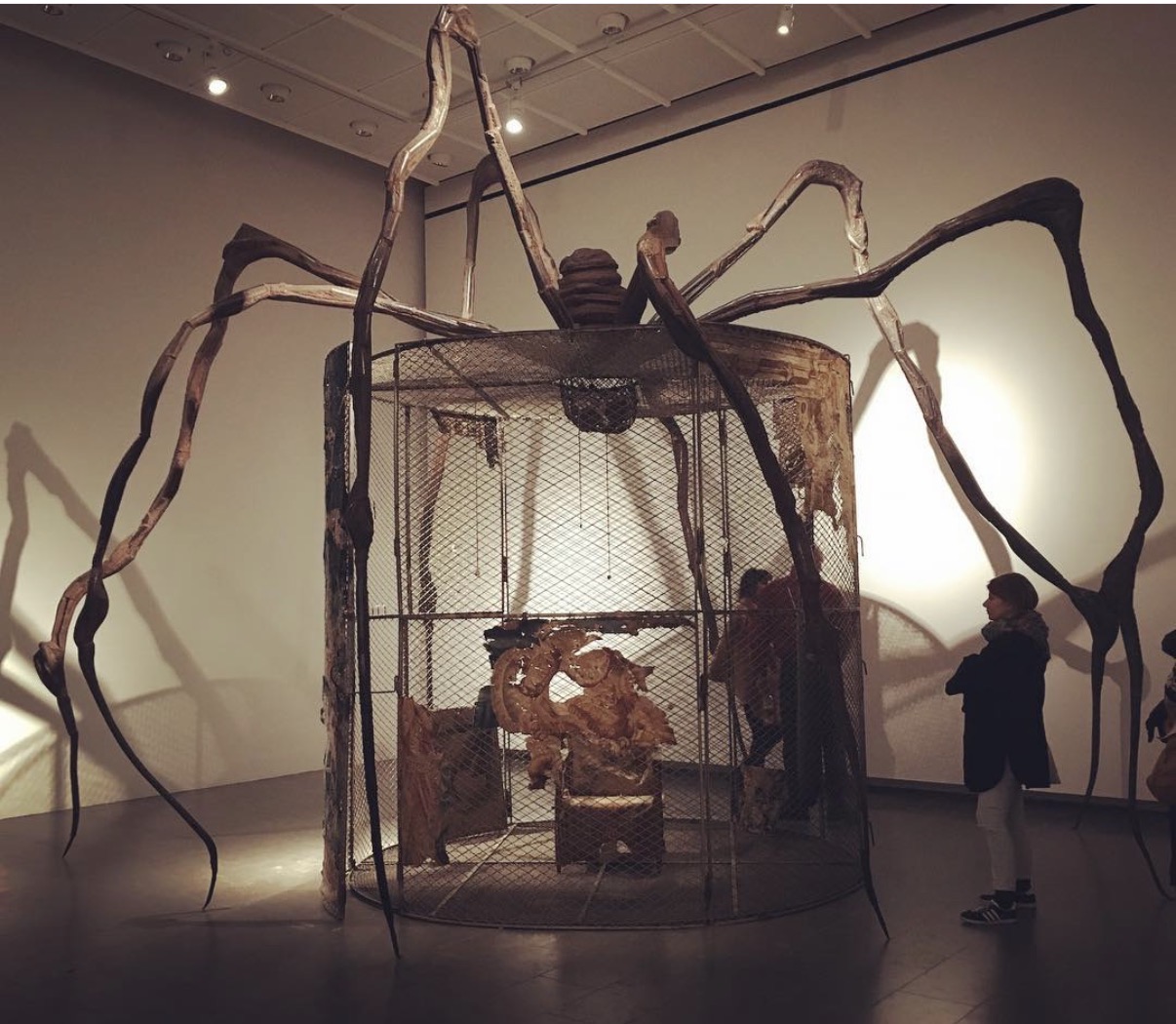
Louise Bourgeois achieved significant recognition for her work later in life. Her decades of experience didn’t make her less creative. They gave her more to draw from.
Time doesn’t make us less resourceful. It gives us more material to create from.
It’s Time to Reclaim the Word
I understand what that mentor was pointing to.
The word “midlife” carries decades of cultural baggage. The idea came from a very different time and a very different view of midlife. But over the years, “midlife crisis” became a stereotype.
Chimamanda Ngozi Adichie said, “The problem with stereotypes is not that they are untrue, but that they are incomplete.”
And that is exactly the problem with the midlife crisis story. It tells us one possible experience of midlife — but not the whole story.
But I don’t think the answer is to abandon the word. The answer is to reclaim it.
Because the women I work with are not experiencing midlife as a crisis. They are experiencing it as a moment to reconsider.
To reassess what they want.
To recognise what no longer fits.
To question choices that once made perfect sense.
And, when they have the right support, they can design their careers with a clarity they may not have had at thirty.
That isn’t a crisis. That’s maturity in action.
Midlife doesn’t have to be a crisis. It can be a point of clarity. A point of courage. A point where you finally give yourself permission to ask:What do I want next — and what would it look like to build it on my terms?
Change the Words, Change the Story
There is a principle from NLP that I come back to often: the language we use to tell our story doesn’t just reflect our past. It dictates how we experience our present.
Think about what happens in your body when you hear the phrase: Midlife crisis.
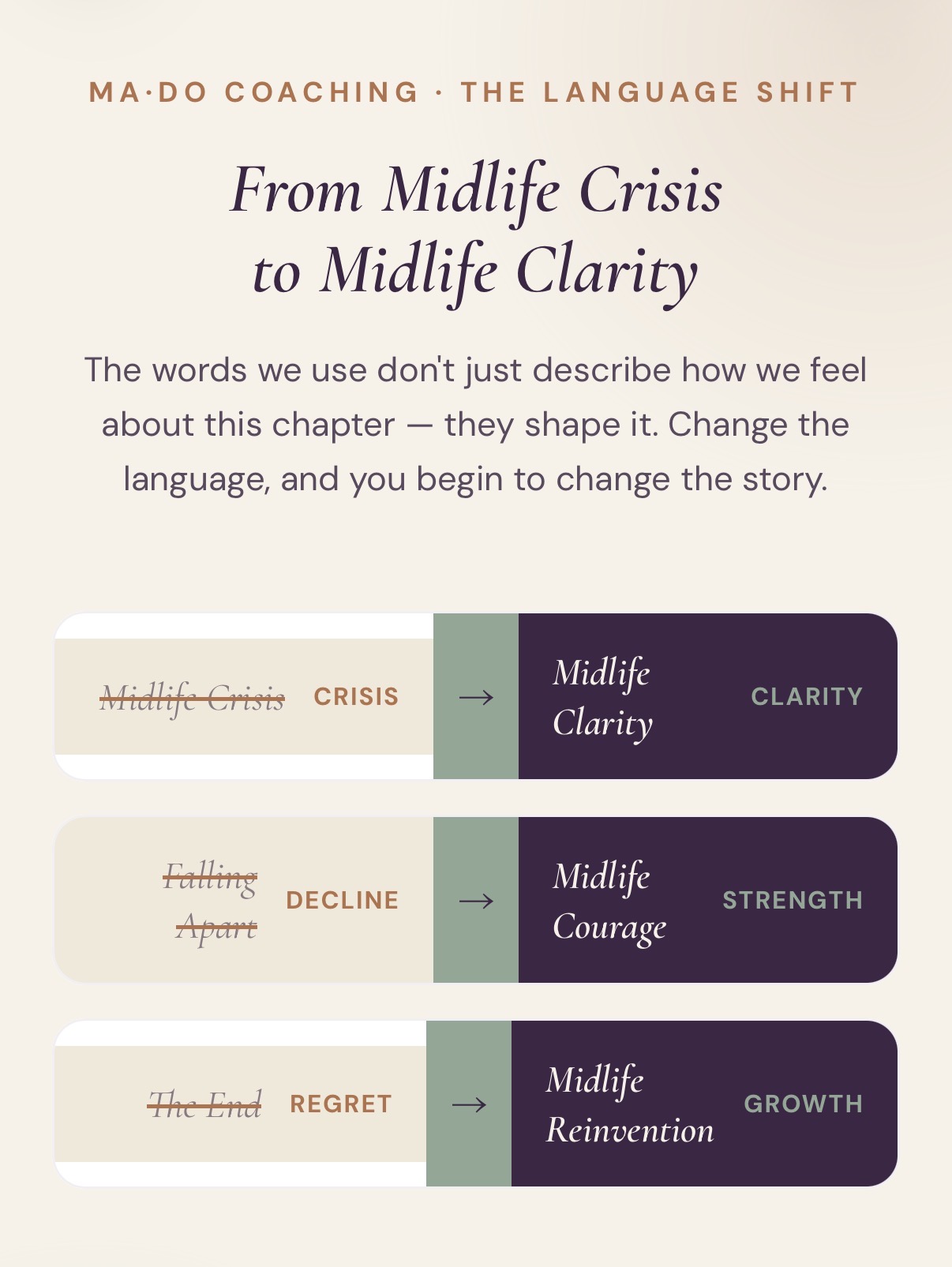
The words themselves carry a lot of weight. Crisis. Decline. Regret. They suggest that something is going wrong — that this is a stage to get through rather than a stage to grow into.
Now try this instead:
Midlife Clarity
Midlife Courage
Midlife Reinvention
Same stage of life. A completely different possibility.
This isn’t about pretending the challenges aren’t real. They are. Changing the words doesn’t change the reality. But the words we use can influence what we believe that reality means — and therefore what we believe is possible within it.
When we stop bracing for a crisis and start recognising a transition, we create space for a different conversation. And sometimes that shift in language is where the transformation begins.
Midlife Is Not Aging. It Is Growing.
Not because everything becomes easier. But because we can finally have enough experience to see ourselves — and our choices — differently.
We arrive at a point where we know more about what gives us energy, what drains us, what matters to us and what we are no longer willing to compromise.
We can begin making choices that are genuinely ours.
Not shaped only by who we thought we should be.
Not dictated by what was expected of us.
Not kept in place simply because we have already invested so much time in them.
For me, the physical and emotional challenges of midlife weren’t just difficult things to get through. They were signals.
They made it harder to ignore the gap between the life I had built and the life that actually fitted who I was becoming.
Learning to read those signals rather than simply resist them was the beginning of designing a life that felt more like mine. And that is why I don’t want to hide from the word midlife. I want to change what it means.
You are not starting over. You are starting from everything you have already built — with experience, perspective and values that have been earned, not inherited.
The Midlife Shift
We have been handed a singular story about midlife: that it is a crisis to be managed or survived.
But the discomfort you might feel during this transition is not a crisis at all.
Instead, look at the transition through a different lens: What if your discomfort isn’t a sign that something is wrong, but rather a piece of information?
If this perspective is lingering in the background of your life, I’d love to know how you are answering it.
There is more to midlife than the rigid stereotype we’ve been given. There is questioning. There is change. And there is the possibility of choosing differently because you know yourself differently now.
That is the shift—and it is a story that deserves to be told.